


Why Your Reactive Dog Training Plan Needs to Fit Your Real Life
Consistent progress in reactive dog training doesn’t require a perfect routine. It requires a plan that works for your dog and for the life you actually have.
Living with a reactive dog can make it feel as though training is supposed to become your second job. You may be trying to avoid crowded sidewalks, prepare for visitors, manage barking at the window, practice training exercises, provide enrichment, and still handle everything else in your life.
When you can’t keep up with every recommendation, it’s easy to feel like you’re failing your dog. You’re not!
It’s far more likely that the training plan is asking for more time, energy, or organization than you currently have available.
An effective reactive dog training plan supports your dog without overwhelming you. The best plans aren’t the ones that look perfect on paper, they’re the ones you can actually follow consistently enough to create meaningful change.

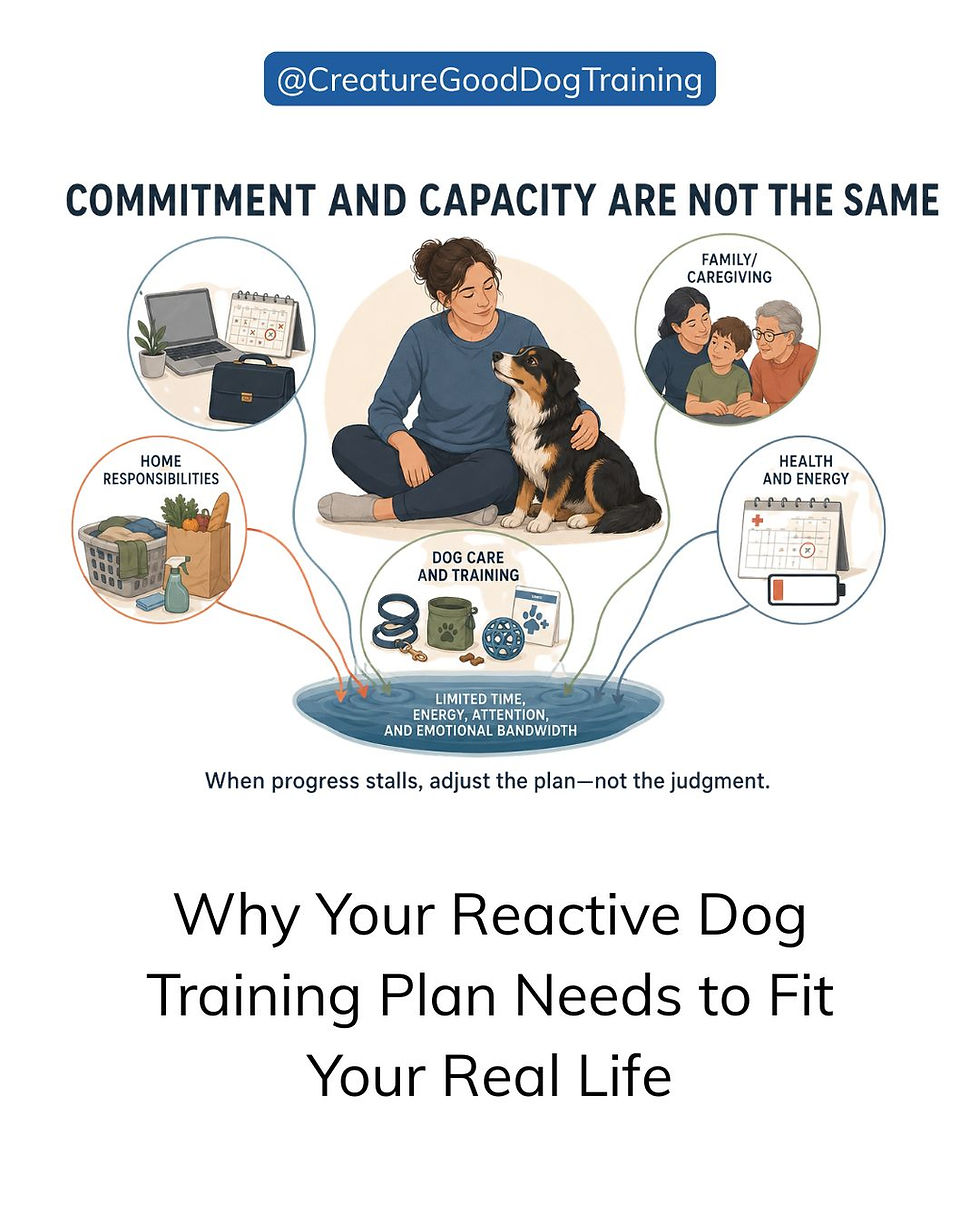
Commitment and capacity are not the same thing
You can be deeply committed to your reactive dog and still have limited capacity. Capacity includes your available time, physical and emotional energy, health, finances, family responsibilities, living environment, and access to support.
A person managing a chronic illness, for example, may need a different plan than someone with abundant energy. A family with young children will need different options than someone who lives alone. A dog in a city neighborhood faces different challenges than a dog in a rural area. None of these differences tells us how much a person loves their dog.
What they do tell us is what kind of reactive dog training plan is most likely to work.
When a plan repeatedly falls apart, it doesn’t automatically mean you lack motivation - or even that it’s a “bad” plan. Difficulty following the plan is a sign that something is getting in the way. Identifying the obstacle gives you and your trainer the chance to make the plan more practical for your situation.
Why an ideal training plan can still fail
A technically excellent plan is only useful if the people living with the dog can carry it out. If a plan requires several long practice sessions, complicated setups, constant recordkeeping, or specialized equipment that’s difficult to use, you may begin with enthusiasm and quickly become demoralized.
This is especially discouraging for reactive dog parents. You’re already coping with stressful walks, changes to your social life, worry about what might happen, and even grief for the easygoing dog mom life you thought you’d have. Adding an unsustainable training routine just makes you - and your dog - more stressed.
Starting smaller isn’t lowering your standards, it’s a strategic way to produce early success, reduce pressure, and build the confidence needed to continue.

Four ways to make reactive dog training more manageable
A realistic plan can usually be created by looking at four things: what to prioritize, what to simplify, where to integrate training, and what needs to be adapted.
1 Prioritize what will help most right now
Reactivity is a complex set of dog behaviors and effective plans need to address many issues. That said, you don’t have to address them all at once. The best thing to do is determine one change - in your routine, environment, etc. - that gives you the most immediate relief.
Maybe you change when you walk to lower traffic times, prevent access to a home location where your dog barks the most, stay further away from triggers, or change the gear your dog wears on walks. The right starting point depends on you, your dog, your situation, and what’s currently causing the greatest strain.
Early success is important. Experiencing quick results is empowering and reduces stress for you and your dog. Even small successes early on enable reactive dog parents to have a hopeful vision of the future.

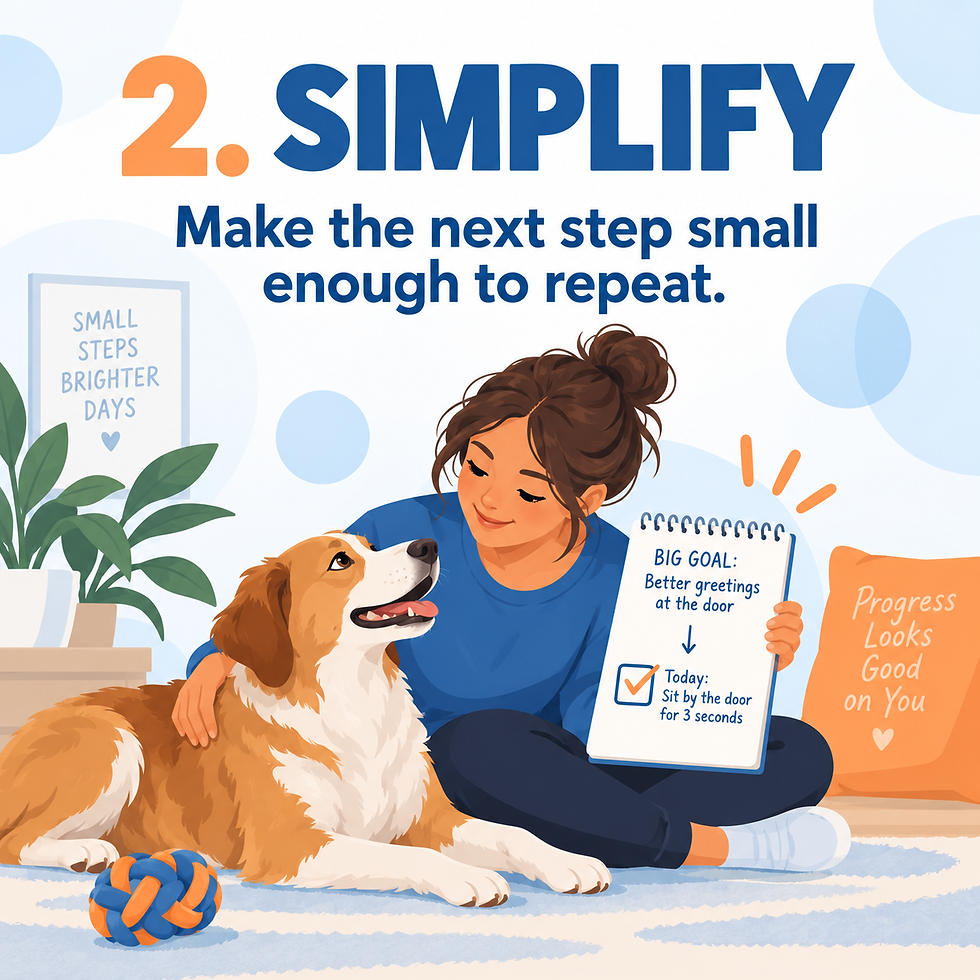
2. Simplify the task
The more steps, decisions, and materials a task requires, the harder it is to repeat consistently. What’s the smallest version of a training task or assignment that will be successful?
Let’s say that, ideally, you would practice with your dog for 30 minutes a day, but you honestly don’t have the time or energy for that. Ask yourself how much time and energy you do have. The reality is that practicing for two minutes a day results in more success than practicing zero minutes a day. Rather than not do something because it’s too much, break it down into something you actually can do. Similarly, you can focus on one skill instead of five or watch a five minute demonstration video or short article instead of an hour long masterclass or full book.
The smallest action you can repeat will take you further than an ambitious plan you abandon. Once the easier version becomes part of your routine, you can build on it for even bigger results.
3. Integrate training into routines you already have
This is one of my favorite tips: the simplest way to add a new task to your schedule is to connect it to something you already do. Finding a separate block of time for dog training can be difficult, but adding five minutes of practice before or after your dog’s daily walk makes it much easier to follow through. If you truly don’t have an extra five minutes, use the first five minutes of the walk for practice and make the walk itself five minutes shorter. That small investment can help your dog feel more settled, making the rest of the walk calmer and more enjoyable for both of you.
Another idea is to practice one skill before putting down your dog's breakfast or play together for five minutes before dinner.
Training doesn't always need to be a formal session. Play, enrichment, decompression, thoughtful management, and responding to your dog's early signals all support your larger goals.

4. Adapt the plan when something isn't working
If there’s a section or activity in the plan your trainer gives you that you find too difficult, rather than try anyway or give up, ask your trainer to explain it differently. Ask why it’s important. Even ask how it can be made simpler for you. Getting curious about what challenges you is often the best way to find solutions.
Perhaps the leash-handling technique being recommended is uncomfortable because of a hand or shoulder problem. Maybe the recommended practice location is busier than expected. Perhaps another family member is unwilling to participate, or the instructions make sense during the lesson but feel confusing later. Your trainer should be happy to find workable adaptations.
Many barriers are surprisingly fixable once named. The answer may be different equipment, a quieter location, a simpler explanation, another way to practice, or a smaller assignment. Your trainer needs to know what is difficult so the two of you can create a plan that works for your actual life.
One caveat for this is please don't adapt the plan without consulting your trainer. You may accidentally leave out or change a vital step that renders the activity useless or worse - worsens the problem you're trying to fix!

What counts as progress with a reactive dog
Progress is not limited to your dog walking past every trigger without barking or lunging. Those visible changes matter, but they’re not the only evidence that training is working.
It’s also progress when you notice your dog's tension earlier. It’s progress when you create distance before your dog reacts, advocate for space, recover more quickly after a difficult encounter, or choose not to put your dog in a situation they can’t yet handle.
It’s progress when your dog looks to you for help, when you understand each other a little better, or when life together begins to feel slightly less tense. These small changes only you notice create the foundation for the behavioral improvement everyone can see later.
Consistency matters more than perfection
Reactive dog training is not a test of how much you love your dog. You do not have to prove your commitment by exhausting yourself or following an ambitious plan perfectly.
Choose the most useful next step. Make it small enough to repeat. Connect it to something you already do. If it still does not fit, adjust it.
Your dog does not need an imaginary version of you with unlimited time and energy. Your dog needs support from the real you. The right plan makes that possible.
When you need help creating a realistic plan
If you feel overwhelmed by your dog's reactivity or unsure what to prioritize, professional support will help you identify the changes most likely to bring relief. At Creature Good Dog Training, I work with both ends of the leash, creating practical plans that account for your dog's behavior and emotional needs as well as your capacity, environment, and goals.
You don't need to do all the things all the time. You need a starting point that works for you and your dog.


Comments